
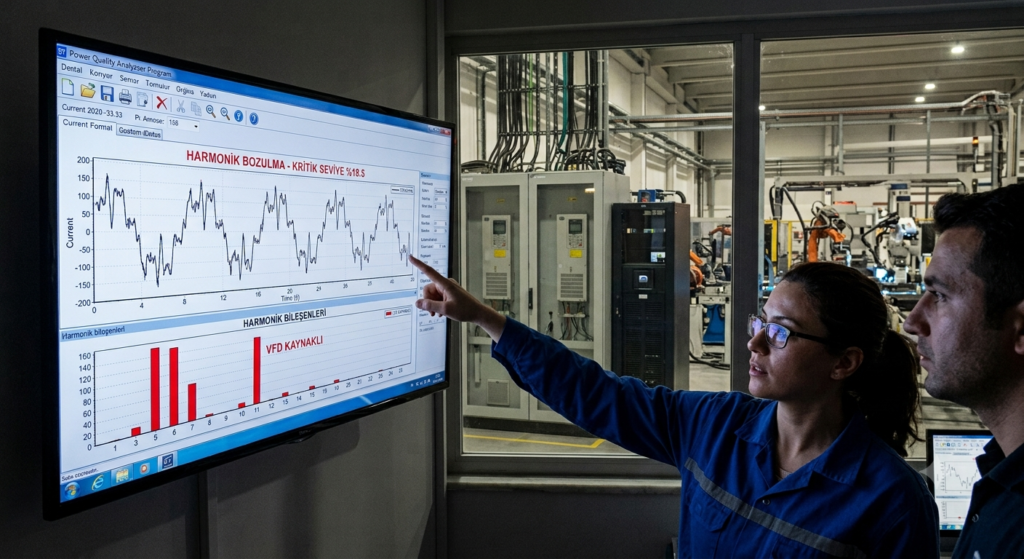
What is harmonic distortion, how is it measured, and how can it be mitigated? Harmonic analysis and filtering solutions for industrial facilities in accordance with IEEE 519 and IEC 61000 standards.
What Is Harmonic Distortion? Measurement and Mitigation Guide for Industrial Facilities
With the widespread adoption of variable frequency drives (VFDs), uninterruptible power supplies (UPS), welding machinery, and power electronics in modern industrial plants, harmonic distortion has become an increasingly critical operational challenge. Uncontrolled harmonic levels lead to severe equipment overheating, unscheduled production downtime, and inflated utility bills.
What Are Harmonics?
In an ideal power system, the voltage and current waveforms are pure 50 Hz sine waves. Harmonics are unwanted sinusoidal currents or voltages that operate at integer multiples of the fundamental power frequency, distorting the ideal waveform:
3rd Harmonic: 150 Hz
5th Harmonic: 250 Hz
7th Harmonic: 350 Hz
11th Harmonic: 550 Hz
These parasitic frequencies adversely impact power transformers, electric motors, cabling, and switchgear assemblies.
Sources of Harmonics
Common non-linear harmonic-producing loads in industrial facilities include:
Variable Frequency Drives (VFDs/Inverters): The primary source of industrial harmonics
Welding Equipment and Arc Furnaces
UPS Systems and Static Inverters
Power Factor Correction Capacitors: High risk of harmonic resonance
IT Infrastructure and Data Center Equipment
LED and Fluorescent Lighting Systems
Detrimental Effects of Harmonic Distortion
Impact on Equipment:
Excessive thermal stress and reduced efficiency in power transformers
Stator/rotor heating and premature insulation breakdown in electric motors
Capacitor degradation and explosion risks due to resonance
Nuisance tripping of circuit breakers and protective relays
Accelerated degradation of cable insulation
Impact on Plant Operations:
Unplanned production outages
Increased operational energy losses
Shortened equipment service life
Communication bus errors in SCADA, PLC, and telemetry networks
How Is Harmonic Measurement Conducted?
Field testing and harmonic analysis follow a structured technical workflow:
Selection of Measurement Points
Primary switchboards, transformer secondaries, and dedicated feeders supplying major non-linear loads serve as primary audit locations.
Power Quality Analyzer Logging
Continuous data logging is executed for a minimum of 7 days using class A power quality analyzers, such as the Fluke 435 or Hioki PW3198.
Technical Reporting and Compliance Evaluation
Recorded data is evaluated against threshold limits established by IEEE 519 and IEC 61000-3-12:
| Parameter | IEEE 519 Threshold | IEC 61000 Threshold |
| THD-V (Total Harmonic Distortion – Voltage) | 5% | 8% |
| THD-I (Total Harmonic Distortion – Current) | 5%–20% (Load dependent) | Per standard tables |
| Individual Voltage Harmonic | 3% | 5% |
Harmonic Mitigation Solutions
Passive Harmonic Filters (PHF)
Tuned LC circuits designed to attenuate specific harmonic frequencies. Highly cost-effective, though prone to system resonance if grid impedance shifts.
Active Harmonic Filters (AHF)
Power electronics systems that measure harmonic currents in real time and inject counter-phase currents. Represents the most effective mitigation technology, featuring platforms from industry leaders like Schneider Electric, ABB, and Danfoss.
12-Pulse or 18-Pulse Transformer Topologies
Utilizing multi-winding phase-shifting transformers for drive power supplies inherently cancels out 5th and 7th harmonic orders.
Line Reactors (Series AC Reactors)
Installing series reactors at VFD inputs reduces current harmonic distortion by 35% to 50%, serving as an economical first-line defense.
Detuned Capacitor Banks (Detuned Filtering)
Integrating series detuned reactors with power factor correction capacitors prevents harmonic resonance conditions in polluted networks.
Regulatory Mandates and Engineering Standards
Harmonic emissions in Turkey are governed by national regulations and international engineering standards:
EMRA (EPDK) Electricity Market Grid Code: Sets limits for harmonic injection at the Point of Common Coupling (PCC)
IEC 61000-3-2 / IEC 61000-3-12: Emission limits for equipment connected to low-voltage networks
IEEE 519-2022: Standard for harmonic control in electric power systems
TSE EN 50160: Voltage characteristics of electricity supplied by public distribution networks
TEDAŞ Technical Specifications: Network connection requirements for distribution grids
If harmonic distortion limits are exceeded at the PCC, the regional distribution company may mandate the installation of harmonic filters or enforce grid disconnection.
Periodic Harmonic Monitoring Schedule
Because plant harmonic profiles evolve as loads change, the following inspection schedule is recommended:
Annually: Full power quality audit and harmonic analysis
Upon Facility Expansion: Re-measurement following the installation of new non-linear loads
During Production Scale-up: Harmonic impact assessment under peak operating conditions
Capacitor Systems: Inspection of detuned filtering components every 6 months
⚠️ Legal Notice and Disclaimer
The technical details, statutory references, and engineering standards cited in this article are provided solely for general informational purposes. Applicable regulations, technical specifications, and standards in Turkey are subject to updates. You are required to verify current provisions directly through official resources, including the Official Gazette, EMRA (EPDK), TEDAŞ, and recognized standards organizations (TSE, IEC, IEEE).
Every industrial facility exhibits a unique harmonic profile, load mix, and grid impedance profile. Consequently, no technical information contained herein should be interpreted as a definitive engineering recommendation or directly executed without site-specific engineering analysis.
AYÇE Endüstriyel Makina İnşaat Elektrik Taahhüt San. ve Tic. Ltd. Şti. disclaims all liability for any direct, indirect, financial, or legal damages arising from the implementation of the information presented above. Always engage an authorized electrical engineer or power quality consultant to evaluate and resolve your site-specific harmonic issues.